
Review: ABT@85 – Innovations Past and Present
October 29, 2025 – David H. Koch Theater, Lincoln Center, NYC
TL;DR: Nunes’ Have We Met?! lands as a cinematic, emotionally precise story ballet; Ratmansky’s Serenade after Plato’s Symposium rewards focused listening; I missed Theme and Variations to catch a flight—yet the evening felt complete.
On October 29th, I had the chance to travel to New York to watch one of my favorite choreographers — someone I truly believe represents the future of ballet. I attended ABT@85: Innovations Past and Present, and what an evening it was.
I arrived early that morning in New York City, a place that never loses its charm or energy. I spent the day people-watching, walking through Central Park, and soaking in the city’s creative pulse — hearing everything from Portuguese to languages I couldn’t even recognize. New York is endlessly rich in culture. Posters for theatre plays, live orchestras, and ballet performances fill every corner; there’s simply too much to take in. Even with all its challenges, it remains a magical city — one where art and diversity constantly collide.
I wish “ballet-hopping” could actually be considered a form of tourism — fly in, watch a masterpiece, and go home inspired. That day, I managed to walk up to the box office and get a rush ticket with a surprisingly good seat. The show was at 7:30 p.m., so I still had time to wander and, as always seems to happen in New York, I ran into someone from my past. Around 6 p.m., I stopped by The Smith for a drink and realized the person sitting next to me was someone I used to work with at the Kennedy Center, back when I was with Suzanne Farrell Ballet. What a small world. We reminisced about those days and about Suzanne — one of the most inspiring ballet icons I’ve ever met.
Around 7 p.m., I walked across the street to the David H. Koch Theater. The theater is breathtaking, especially its golden foyer — it always feels like stepping into another world. That night’s program featured three ballets:
Have We Met?! – World Premiere by Juliano Nunes
Serenade after Plato’s Symposium – Alexei Ratmansky
Theme and Variations – George Balanchine
• Have We Met?! – Choreography by Juliano Nunes
Music by Luke Howard | Set and Costume Design by Youssef Hotait
The night opened with Nunes’ new ballet, Have We Met?! — a story ballet that feels universal, familiar, and deeply human. It tells the love story of Rose and Julian, separated by the tragedy of the Great War, only to meet again 110 years later as Orion and Arya. The idea that love can transcend lifetimes, that two souls might be written into each other’s DNA, was portrayed with such delicacy that it struck something deep in me. I think everyone, at some point, has met someone who feels strangely familiar — as if they’ve known them before.
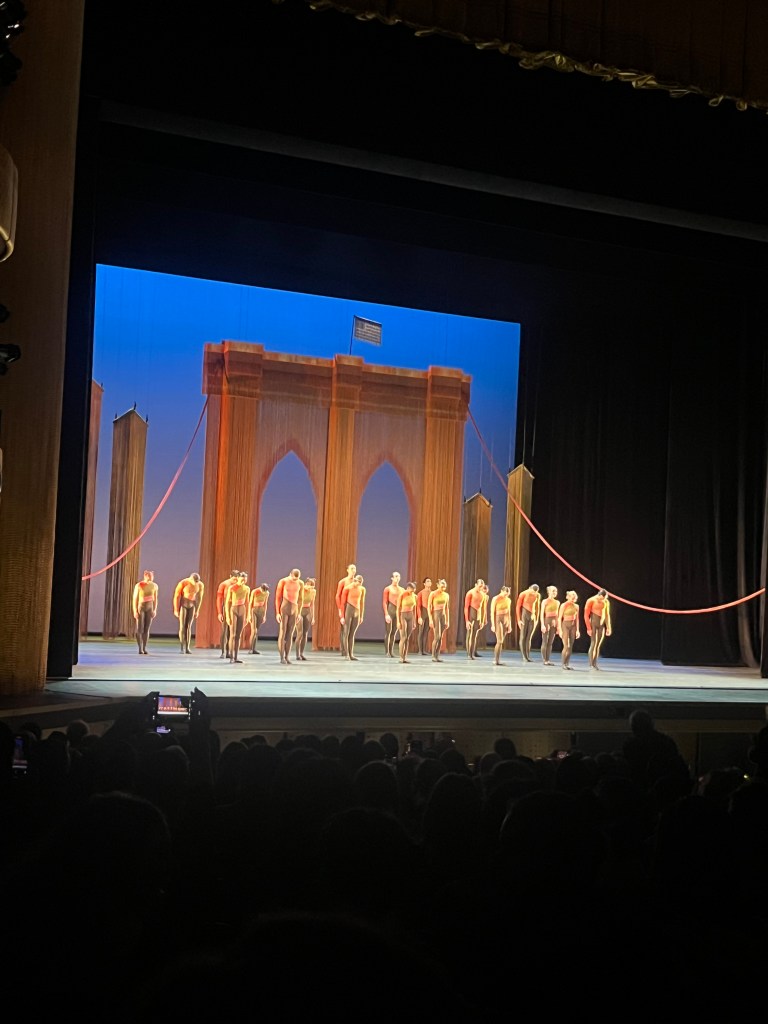
The ballet began in silence: Heo Seo and Isaac Hernández approached each other slowly, discovering each other through movement. Then the backdrop lifted, revealing a stunning set — the Manhattan Bridge, delicately constructed with strings. It was breathtaking, far beyond what I’ve seen in some recent large-scale narrative ballets. The corps de ballet, dressed in dark, era-appropriate costumes with long gloves, created a strong and clean visual impact — such a simple but brilliant design choice.
Nunes’ choreography carried his unmistakable aesthetic — fluid, intricate, and deeply musical. His use of space and structure gave the piece a cinematic quality. When Isaac Hernández danced his solo, I got chills. His artistry, power, and emotional surrender were remarkable — you could feel his pain, not just see it. He is, without exaggeration, one of the best dancers I’ve ever seen live.
The second half, set in 2038, began again in silence with Daniel Camargo and Catherine Hurlin as Orion and Arya. This time the atmosphere was lighter, colorful, and modern. Camargo and Hurlin danced with great connection, though I personally found Hernández’s performance more compelling — his presence felt raw and magnetic. The male corps particularly impressed me in this section — sharp, present, and powerful. The ballet closed with a sense of renewal and lightness, suggesting that love and destiny repeat until peace replaces tragedy.
Nunes continues to bring something truly different to ballet today. In my opinion, he’s shaping what ballet will evolve into next — carrying forward the musical intelligence and emotional honesty that choreographers like Liam Scarlett once brought to the stage. I can’t wait to see Nunes’ Romeo and Juliet with Philadelphia Ballet this coming spring.
• Serenade after Plato’s Symposium – Choreography by Alexei Ratmansky
Music by Leonard Bernstein | Sets and Costumes by Jerome Kaplan
Ratmansky’s Serenade after Plato’s Symposium opened with a fascinating stage image — a stretched square above the dancers covered in writing (I believe in Cyrillic). The ballet features seven men and one woman, each representing a different perspective on love inspired by Plato’s dialogues.
At first, I wasn’t sure about the costume design — the loose pants, especially for James Whiteside, dragged and hid the dancers’ lines. But as the piece unfolded, the music, the structure, and the intention behind each section began to pull me in.
Ratmansky’s choreography is complex, intellectual, and layered. It’s a conversation through movement — at times analytical, at times spiritual. He uses every beat of Bernstein’s score, intertwining rhythm and counterpoint like dialogue. It’s not choreography that asks you to feel immediately — it asks you to listen and reflect.
Calvin Royal III performed with extraordinary lyricism — weightless, musical, and serene. Watching him felt like watching poetry glide through air. Takumi Miyake, in contrast, delivered explosive virtuosity — his jumps and turns had precision and fire, yet he never lost control or musicality. Herman Cornejo, ever the master technician, danced with clean lines and depth, showing why he remains one of ABT’s great artists. Sunmi Park, the lone woman, carried her role with elegance and quiet power, weaving through the men as both muse and equal.
Ratmansky reminds us that choreography can be both cerebral and emotional — his work here felt like a reflection on the essence of love: intellectual, physical, spiritual, and imperfectly human.
• Theme and Variations – Choreography by George Balanchine
Music by Tchaikovsky
Sadly, I had to leave before Theme and Variations began to catch my flight to Europe — but even without seeing it, the evening already felt complete. It was a perfect balance of innovation, reflection, and reverence for ballet’s past and future.
Final Thoughts:
That night reminded me why I love this art form — how it connects the past, present, and future through movement, emotion, and imagination. From Nunes’ visionary storytelling to Ratmansky’s intellectual depth, ABT’s Innovations Past and Present was a living example of ballet’s evolution — and its enduring beauty.
Review: Evening of Horror — Philadelphia Ballet at the Academy of Music
October 17, 2025 – Academy of Music, Philadelphia, PA (Friday)
TL;DR: De Mille’s Fall River Legend reads theatrically clear; Nunes’ Valley of Death is the reason to go—sumptuous design, charged partnering, and a final image that lingers.
Philadelphia Ballet presented an Evening of Horror featuring two contrasting works: Fall River Legend, choreographed by Agnes de Mille to music by Morton Gould, and Valley of Death, a world premiere by Juliano Nunes set to the music of Sergei Rachmaninoff and Ralph Vaughan Williams, with costumes and scenery by Youssef Hotait.
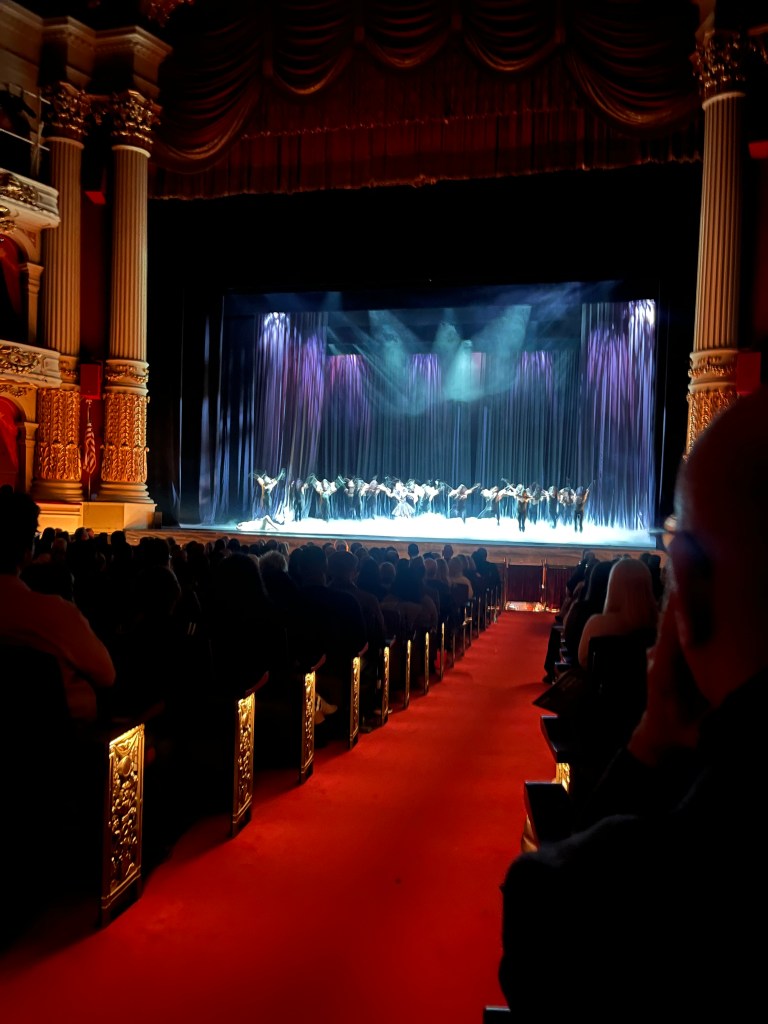
The performance took place at the historic Academy of Music in downtown Philadelphia—a breathtaking theater. I arrived early enough to sit and take in its beauty for about twenty minutes before the show began. From the ceiling paintings of angels to the gilded ornamentation and rich acoustics, the setting alone was an experience.
I hadn’t planned to see this performance originally. My schedule has been packed, and I only found out on Thursday that Nunes’ new work would premiere this weekend. Juliano kindly offered me two tickets, and as someone who’s followed his journey for years, I couldn’t miss the chance to see it in person. It was my second time attending a Philadelphia Ballet performance—the first being Forward Motion, a triple bill that also featured one of his premieres. Since Nunes is the company’s resident choreographer, it’s common to see his works appear regularly in their repertory, each revealing a new layer of his evolving artistry.
Fall River Legend — Agnes de Mille
The evening opened with Fall River Legend, a dramatic retelling of the Lizzie Borden story. The production carried a Broadway-like theatrical flair, especially with the clever inclusion of the “Speaker of the Jury,” whose narration guided the audience through the story. For newcomers to ballet, that touch made the work accessible and engaging.
The piece drew laughter at moments and showcased strong acting from the dancers, but from a choreographic standpoint, it felt somewhat simple for a company of Philadelphia Ballet’s level. The women’s costumes were elegant and era-appropriate, but I found the men’s costumes unflattering—they lacked silhouette and failed to emphasize the dancers’ lines, diminishing the visual strength of the male ensemble.
Principal dancer Mayara Piñeiro delivered a compelling performance, embodying the storytelling style required for de Mille’s choreography. I had seen her dance before during my previous visit, and she continues to impress with her dramatic and technical clarity. The orchestra, as expected, was excellent—precise, warm, and expressive. Overall, Fall River Legend was a solid production, if not a particularly demanding one for a company of this caliber.
Valley of Death — Juliano Nunes (World Premiere)
The second piece of the night—and the reason I made the six-hour drive to Philadelphia and back—was Juliano Nunes’ Valley of Death. I’ve followed Juliano’s artistic path since before his choreographic career truly began, back when he expressed his artistry through painting and poetry. That same sensitivity and depth remain evident in his choreography today.
The stage design was striking: a massive red velvet drape shaped like a grand ballroom curtain hung across the back, framed by three chandeliers—one large at center and two smaller on the sides. The deep reds against a dark, almost shadowy background immediately set a gothic and suspenseful tone.
The dancers entered in dark, elegant costumes, performing intricate partnering sequences that reflected both tension and intimacy. Yuka Iseda (Agatha) was exceptional—musical, precise, and entirely in sync with Nunes’ choreographic voice, where every note finds its own gesture. Ashton Roxander (Oscar) danced with a strong, clean presence, while So Jung Shin (Beth) offered lyrical contrast with her soft port de bras and fluid transitions.
One thing I particularly admire in Juliano’s work is how he often plays with androgyny and costume fluidity—placing men in tutus or designs that blur gender expectations. It’s never done for effect, but rather as an extension of his artistic vision, where movement transcends identity. In Valley of Death, it took me a while to realize that some dancers I initially thought were women were in fact men, and that ambiguity made the piece even more intriguing. It reminded me of his earlier work Interlinked, created for the Royal Birmingham Ballet, which also featured a strong androgynous presence—moments where you truly couldn’t tell whether you were watching male or female dancers. That fluidity feels intentional, adding another layer of beauty and inclusivity to his choreography.
Nunes’ work challenges dancers both technically and emotionally, and the cast met that challenge with commitment and nuance. One of the most powerful moments came when the dancers lifted Agatha and Oscar as the chandeliers and red velvet rose into darkness, the stage engulfed in smoke. The image was haunting—like time and memory dissolving into the void.
Youssef Hotait’s costume designs added an essential dimension to the work, especially Agatha’s gown with its structured shoulders. The design amplified Iseda’s movement, expanding her upper-body expression and magnifying the drama of each phrase.
Valley of Death was an unforgettable experience—visually rich, emotionally charged, and executed with precision. Philadelphia Ballet danced beautifully, fully embodying Nunes’ vision. I left the theater both inspired and eager to see his upcoming world premiere with American Ballet Theatre on October 29th.
Review: Jewels — Pacific Northwest Ballet
October 3, 2025 – Seattle, WA (Friday)
TL;DR: Women drive the night in Emeralds and Rubies; Diamonds crowns the program with commanding leads (Jonathan Batista & Angelica Generosa) and a cohesive corps.
As many of you know, I’ve been traveling across the U.S. to watch performances by friends and colleagues, often seeing their commissions on major ballet companies. Given my professional background, I’ve decided to start sharing my impressions from these performances.
Last night, I attended Pacific Northwest Ballet’s Jewels. I left Ohio at 6 a.m. to make it to Seattle in time not only to see the show but also to support a friend making his debut in Diamonds.
First, I must acknowledge how thoughtfully designed PNB’s facilities are. Having the theater, studios, costume shop, and wardrobe all in the same block creates a strong sense of cohesion and contributes greatly to the dancers’ quality of life. A dancer’s career thrives on routine, and such an environment provides both comfort and stability.
I can’t recall if I’ve seen the full Jewels program before, but I’m very familiar with Emeralds and Rubies, two ballets in which I’ve performed principal roles. That experience lets me watch them through a slightly different lens than Diamonds.
I often joke that the Balanchine Trust holds pieces of Mr. Balanchine’s soul—like Voldemort, but in a positive way. Each répétiteur sets his choreography with their interpretation of what Balanchine intended, meaning each production carries a distinct shade of his spirit.
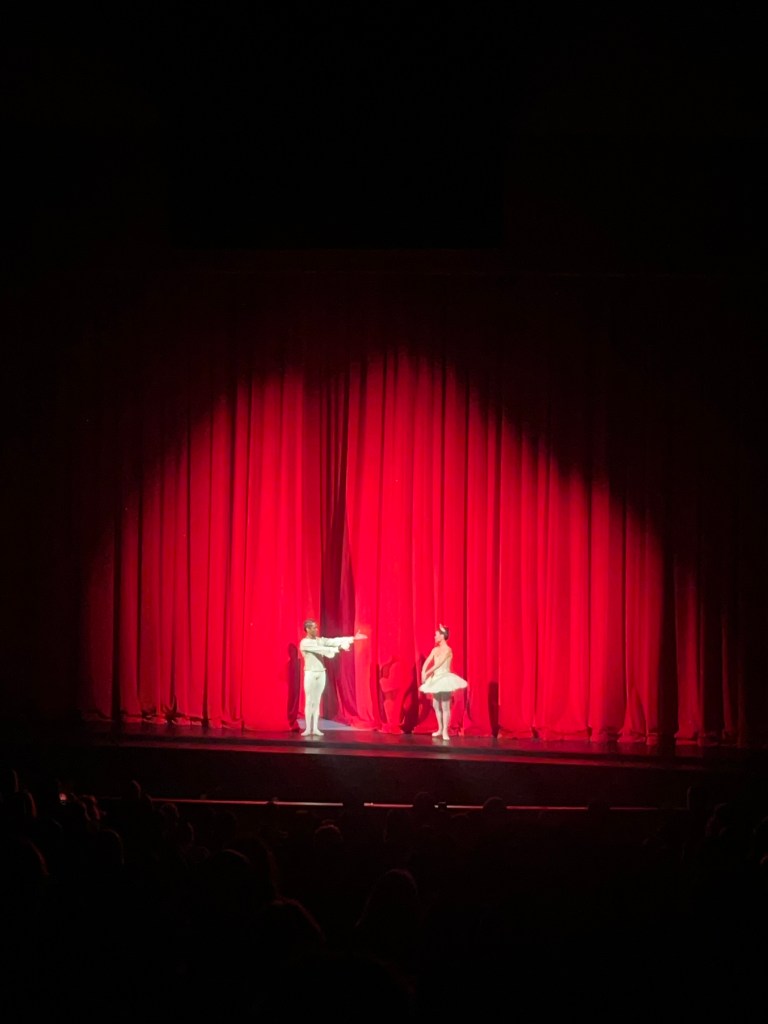
Emeralds opened the evening with the expected sense of beauty—a living painting on stage. The costumes were exquisite, sparkling even from the lobby. The men’s green velvet tunics fit perfectly, and the backdrop evoked a twilight sky over Carmel, California. The women danced with musicality and elegance that captured Balanchine’s vision of femininity. Unfortunately, one of the male leads failed two double tours, marking them rather than committing to the movement. Mistakes happen, but at a company like PNB, technical excellence extends beyond pointed feet—it includes transitions, partnering, and presence. Amanda Morgan gave a standout performance, full of grace and artistry. The three men, however, lacked synchronization, and some stylistic choices diverged from what I’ve learned when coached in this ballet.
Rubies followed and was again dominated by the women’s energy. The costumes worked well overall, though I personally would have preferred the men in red velvet jackets with rhinestone accents to match the women’s sparkle. The principal male dancer was charismatic and entertained the audience, but he occasionally fell off the music and lost the playful looseness the choreography demands. Sarah was beautifully musical, but at times overreached for height in her extensions, sacrificing alignment and making her appear shorter. Rubies should shine with sophistication and control—qualities slightly lost in those moments. Still, the female corps delivered power and precision that elevated the ballet.
Diamonds closed the night triumphantly. Some might assume I’m biased since my friend Jonathan Batista led the performance alongside Angelica Generosa—but even if I tried, I couldn’t find fault. Jonathan has always been a powerhouse, and witnessing his growth over the years fills me with pride. He and Angelica commanded the stage with the regal authority Diamonds demands. The corps de ballet was strong and cohesive, and the men finally matched the level of the women.
I noticed Ashton Edwards among the soloists. While I respect the director’s artistic vision, their arm line felt too masculine beside the other soloists. Ballet is built on contrast and harmony, and regardless of gender, I hope that dancers performing traditionally feminine roles continue to embody that aesthetic quality.
Overall, it was a memorable evening.
While there were moments of uneven execution, the performance reached the level of excellence expected from a company of PNB’s stature—thanks especially to Jonathan Batista and Angelica Generosa, who closed the night on a truly brilliant note.
 Stéphano Candreva